By Travis Henry
RealNewJournalism.com
In the late 90s, I was a young reporter covering east Boulder County for the Colorado Hometown Newspapers desperately wanting to work for the Daily Camera.
When an opening popped up at the Camera for the east county beat I was sure I was a shoo-in. Of course, I thought, the editors at the Camera had to know who I was. I was routinely beating the dailies on important stories ranging from building height regulations in Louisville to prairie dog conservation battles in Lafayette. That had to mean something right?
I sent an arrogant letter and my resume to Kevin, who was the Camera’s city editor at the time, and practically demanded the job. We had a quick phone conversation and Kevin told me there were several qualified candidates and to come back and apply after I’d done more.
The next time I talked to Kevin, my resume was more complete. I had ended up managing the Colorado Hometown Newspapers before moving to the Daily Times-Call and eventually landing the highly coveted Boulder County criminal justice beat. This time Kevin reached out to me offering a job covering Broomfield and the east county, but my loyalty to the TC was entrenched and cops and courts were my true calling.
I stayed at the Times-Call and was lucky enough to participate in newspaper journalism while it still was in its heydey ….. and while most of us were oblivious to its imminent downfall.
In 2000, Boulder County had two fully staffed newsrooms at daily newspapers. Just the Times-Call, based out of Longmont, had more than a dozen reporters on staff, a room full of photographers, a full sports department, editors and, get this, copy editors. The Camera was even bigger.
You could count on at least two reporters from a daily newspaper attending every school board meeting, city council hearing and court proceeding.
One of the two amazing criminal justice reporters at the Camera I was going up against happened to be one of my best friends from college, Chris Anderson. There were times it was like we were living in a movie.
We were both covering some of the biggest stories not only in the state, but in the country, including the JonBenet Ramsey case and the so-called CU recruiting scandal.
After a long day of work, which often pushed against a midnight deadline, we’d meet at a bar. When we were sure both papers had gone to press, we’d discuss the news the other one had unearthed that day. There was no concern over the web those days. All stories went to print first.
I really first got to know Kevin when I was asked to participate in the Boulder County Bar-Press Committee. The committee was formed to try and diffuse the contentious relationship between law enforcement, the public defender’s office and the media.
To put it bluntly, Kevin was a complete badass at these meetings. He was gruff, wicked smart and an unabashed defender of the role journalism played in keeping the criminal justice system accountable. While our newspapers were competitors, it felt good to have him on the side of journalism as a whole.
Stemming from those meetings a subcommittee was created – including CU law professor and attorney Pat Furman, the amazing Honorable Daniel Hale (who has since passed away), myself, attorney Mark Langston, former prosecutor Bill Nagel and super-sleuth Camera reporter Pam Regensberg – to create an all-encompassing criminal justice manual that would “aid the press in understanding the justice system, and aid lawyers in understanding the press.”
Our stated goal was audacious: “The purpose of the manual is to provide useful and helpful information about the American justice system, and particularly about the operation of the justice system here in Boulder County. It is our hope we will not only provide helpful “how-to” information but that we will foster a better understanding of both the strengths and the weaknesses of the system and a greater appreciation of the importance of the justice system to our system of government.”
The manual ended up hundreds of pages long and was a fantastic piece of work at the time. When the nation’s attention turned to Colorado in 2003 after Kobe Bryant was accused of sexual assault, the Colorado Judicial Branch passed out copies to the journalists who flocked here.
I eventually moved on from covering cops and courts to become the editorial page editor at the Times-Call and started experimenting with user-generated content from the internet. This was around 2004, when newspapers were still discussing whether they should even publish stories online or not, so what we were doing was big.
I was lucky enough to be recruited by Scripps and the Rocky Mountain News and jumped ship in 2005 to help launch a bold citizen journalism initiative called YourHub.com. At YourHub.com, we let online users contribute stories and pictures online, without editing or approving them first. This was really big. And scary. This was before Facebook let the world in, HuffPo didn’t exist and AOL chatrooms were still a thing.
And although Kevin and I both now worked for the same company (Scripps owned the Camera at the time), I soon heard that Kevin was temporarily changing jobs to revamp the Camera’s website, including introducing a citizen journalism portal that would be a direct competitor to our initiative in Boulder. He wasn’t going to allow the chumps in Denver to move in on his territory.
Later, when I moved on to Clarity Media Group and helped launch Examiner.com, Kevin would call me whenever he believed one of our thousands of Examiners was repurposing a Camera story. This was before companies like HuffPo and Demand Media made an industry out of “repurposing” stories. He could sense what was coming.
In the late 2000s, newspaper journalists started losing their jobs in large numbers. In 2009, the Rocky Mountain News, Colorado’s oldest and best newspaper, closed up shop. MediaNews Group, aka Digital First, started buying up the state’s newspapers and soon owned the Times-Call and the Camera, an unthinkable scenario just a decade before.
Newsrooms kept shrinking and were consolidated under Digital First, owned by Alden Global Capital, a New York-based hedge fund described by The Washington Post as “one of the most ruthless of the corporate strip-miners seemingly intent on destroying local journalism.”
The Times-Call headquarters were sold and moved out of Longmont. The Camera’s editorial page editor was fired for publishing an attack on Alden. Local journalism was, and is, dying.
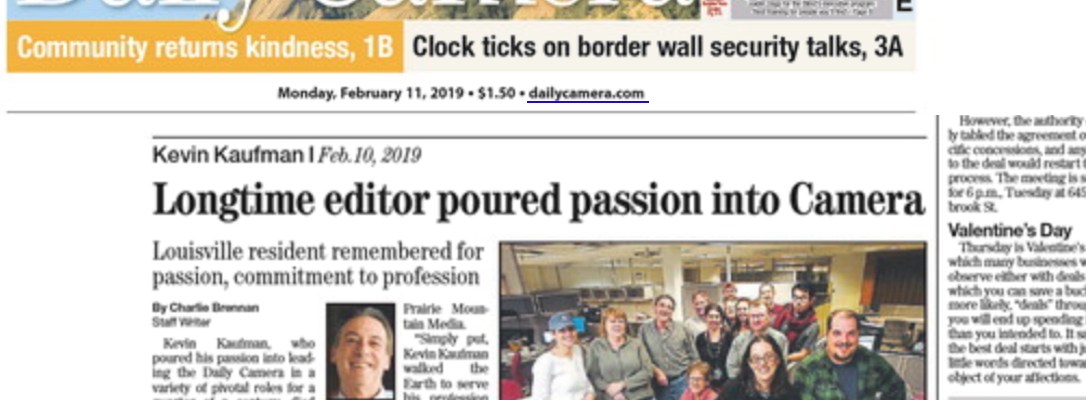
But Boulder had Kevin. When news of Kevin’s death first broke earlier this month, journalists who actually had worked for Kevin started to write columns, fire off Tweets and post on Facebook. Journalists like me, who never worked for Kevin, also chimed in, shocked and saddened at his, what seemed like, sudden passing.
It was clear Kevin, as executive editor for the Camera, was still fighting for journalism, fighting for his newsroom, doing the best he could with the army he had. While local newspapers in Colorado are spiraling, there remains something special about the Camera.
Today there are amazing journalists working at newspaper companies in Colorado, including Boulder and Longmont. I feel bad they don’t get the thrill of competing against a best friend before deadline, and reading each other’s stories in the competition’s paper the next morning.
I feel sorry for the journalists who don’t have a raspy, foul-mouthed, take-no-shit editor going to bat for them against politicians, law enforcement or criminals trying to quash a story. I’ve been lucky to have a few of them.
But I feel worst for the communities, who no longer have at least two reporters at a school board meeting, city council hearing and court proceeding. Reporters are doing their best, but it’s lucky if any of these get covered at all on a consistent basis.
And that’s a shame. Ask any reporter and they will tell you some of the most difference-making stories from their career came from an off-hand comment made during a meeting, a number that didn’t make sense during a budget review or testimony at a routine court hearing.
The good thing about raspy, foul-mouthed, take-no-shit editors is they tend to create and mentor new raspy, foul-mouthed, take-no-shit editors to take their place. While they may be a dying breed, I for one am hoping they still exist.
 Real New Journalism